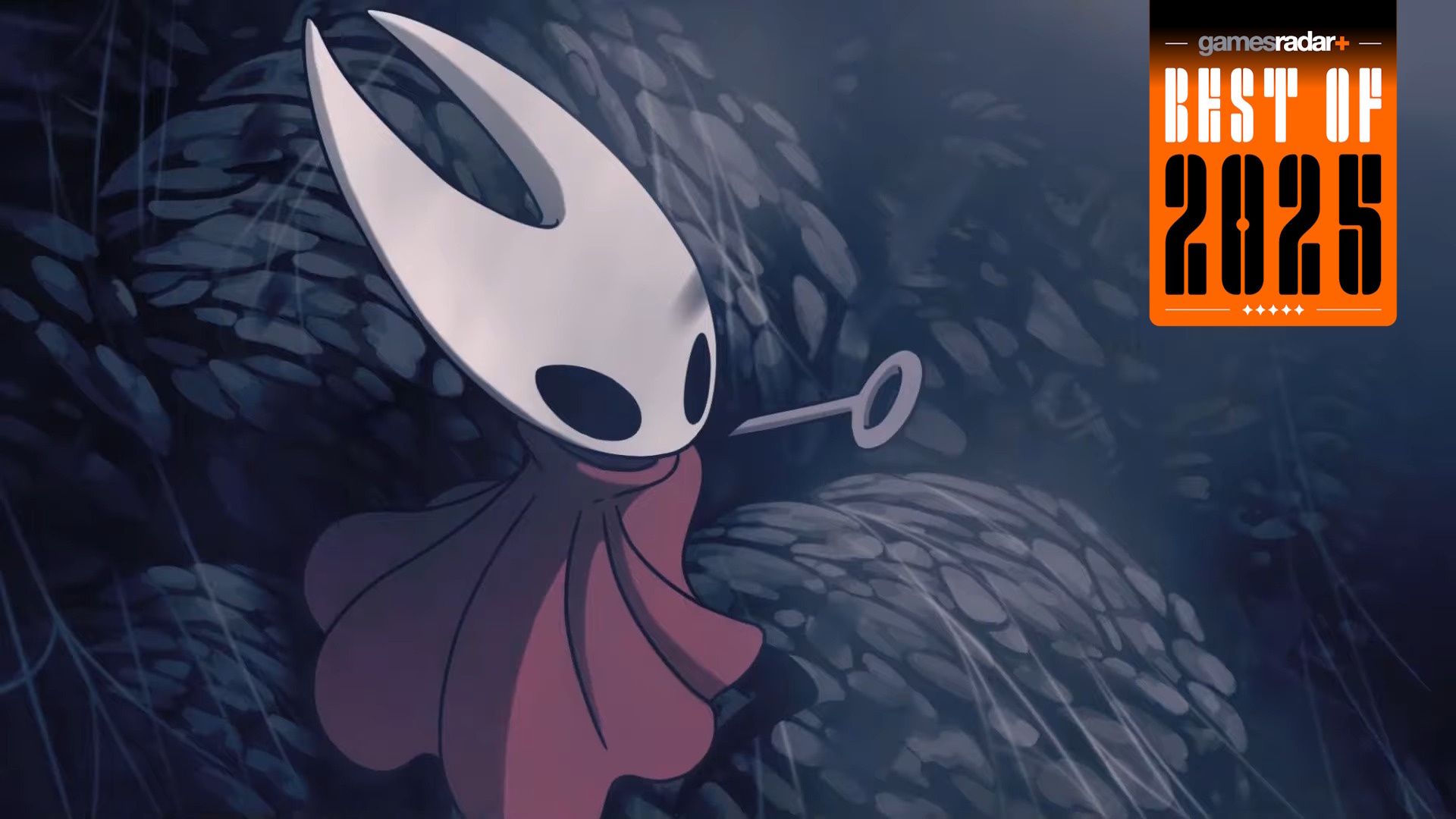
Rarely has “worth the wait” been higher praise than in discussions of Hollow Knight: Silksong. Developer Team Cherry kept Hollow Knight fans waiting for more than six years, mostly in silence so agonizing that people formed a cult for fun, but it didn’t disappoint in the end. Silksong is wonderful. Yet here in this wondrous and foreign post-Silksong era, what’s really stuck with me, even as I crown the game itself my personal 2025 GOTY for a thousand reasons, is the constellation of coincidences which led to the moment that a bug-themed Metroidvania made by a small Australian dev team crashed game stores around the world.
I’ve been covering games for 13 years now, and in that time I’ve never seen another game or launch quite like Silksong. And increasingly, I doubt we will see another. It’s not even about crashing Steam or selling a zillion copies or winning a bunch of awards – all of that is infinitely more likely than the circumstances and effects around this game. And when I lay it out with the clarity of hindsight, I can’t help but think that this was a one-off, in part because it might be foolish to even try to recreate it.
Into the abyss
Year in Review 2025

GamesRadar+ presents Year in Review: The Best of 2025, our coverage of all the unforgettable games, movies, TV, hardware, and comics released during the last 12 months. Throughout December, we’re looking back at the very best of 2025, so be sure to check in across the month for new lists, interviews, features, and retrospectives as we guide you through the best the past year had to offer.
Much has been made of whether the long and quiet wait for Silksong was some stroke of marketing genius, but I’m not really interested in examining it this way. Not just because the folks at Team Cherry have plainly said that they’d simply kept their heads down until they felt they had something substantial to say, but also because marketing is probably the most boring lens we could use to evaluate Silksong. No shade to marketing director Matthew Griffin, the man with perhaps the easiest and hardest job in the world.
Instead, look at the production. The opportunity to dedicate years of full-time work to a game in a crowded genre without any need to fund that labor with other labor, all while living comfortably thanks to the success of a previous project. The decision, free of corporate prodding, to preserve the team and working conditions that led to that success, rather than immediately spin up multiple games in parallel or hire a load of people who’d need to be trained and overseen. The freedom to keep your mouth shut precisely because you don’t need to be aggressive with your marketing, not just because you’re set for life and your next game doesn’t affect your ability to eat or live, but also because you can at any moment look out the window and see clear signs that plenty of people want your game.
Look at the players. Few games present worlds deep enough to ponder and root around in for years, as Hollow Knight fans have done in their own lore tome video essays, filling in gaps in the world and bringing newcomers up to speed. Hollow Knight’s DNA has been compared to Soulslikes, a classification I’ve never fully bought into, but I am reminded of Kiron Ramdewar’s description for the genre and how it may have aided Silksong: “The better Soulslikes have a sense of loneliness and overbearing struggle that almost oppresses the player – their world-building and atmosphere are just as important as their tight hitboxes or twisted enemy design.” This feeling, I think, is catnip for the tireless sickos who are the backbone of any gaming community.

Ramdewar hit on another point, and it’s one Team Cherry recently touched on as well: “A sense of mystery that is becoming rare nowadays.” That was three years ago, and as Team Cherry said just this year, games can feel less mysterious. That’s not always by design, and 2025 has proven there are still plenty of game developers weaving compelling mysteries; it may just be a function of those games existing today. The more compelling the mystery, the faster it will be solved by an online hive mind that’s all gas and no brakes. Silksong was torn apart in days – speedruns, DPS math, hitbox analysis, boss strategies, map routing, webs of item descriptions, and general spoilers galore – but only because its mystery was worth solving.
In the romantic Zelda 2 days that Team Cherry describes in its interview with the ACMI (Australian Centre for the Moving Image), a game’s mystery really could be yours, and it could stay yours for a while with less information at your fingertips. Today you’d have to fight to keep The Algorithm from bringing other people and their thoughts into your space. But an upside to this shift and our connected age is how readily you can exchange ideas and findings to connect with like-minded enthusiasts.

Team Cherry’s silence did end up being a secret ingredient for Silksong, but only as one part of the mystery. This left the floor open for fans to do the heavy lifting, and to do what fans do best: examine and evangelize something they deeply love. Before launch, the crowd of people singing the good word of Silksong had grown so large that it didn’t matter if you loved or even recognized Hollow Knight. You’d just want to know what the heck these people were talking about in every single Nintendo Direct chat. ‘Skong’ became its own entity. In the immortal words of Alfred Molina’s Otto Octavius: “It can’t be stopped. It’s self-sustaining now.”
After launch, all of that anticipation was converted into an equally infectious hunger, a need to understand every facet of Silksong with or without help from creators who have smartly avoided confirming or debunking fan theories because that would kill the magic. Like in any good Metroidvania, it’s not what you find, but how you find it. For years, Silksong was simultaneously known and unknown. We’d seen one face of the cube, enough to spark curiosity but nowhere near enough to get a sense of the thing. Now that we can finally hold it in our hands and examine it from all angles, fans won’t rest until every last cell has gone under the microscope.
All the trouble you’d face above

There’s something else, too – a serendipitous and coveted harmony between the text and the audience which may be the rarest quality in all of this. Silksong is a story of piety and penance, sacrifice and suffering, but also togetherness. Its bug pilgrims band together to weather a long and dangerous journey to a citadel imagined as paradise but shrouded in uncertainty and, we discover, filled with horrors. Protagonist Hornet benefits immensely from the aid and guidance of other bugs and does what she can to help others. Yes, I am sappy enough to enjoy the parallels with all the fans gathering to endure the long wait with faithful Silkposting, but I’m more struck by a clearer comparison born not just of the game’s themes and pre-existing community, but also its core design.
Silksong, you may have heard, is a hard game. Much harder than Hollow Knight. Consequently, the chatter around it, in Reddit posts and YouTube videos and online search trends, has leaned more heavily toward not just DPS math and boss strategies, but a broader sense of how to overcome this. I was here for Hollow Knight in 2017, and the community did not look like this. That is partly down to today’s content machine, but I don’t think that’s the biggest driver. A lot more people find it hard to enjoy and make progress in Silksong because of its mechanical demands, but they’ve tasted the mystery and they want to join in the excitement, and so they’ve turned to the fandom for help. How do you beat this guy? Where can I find this thing? What the fuck is The Last Judge’s problem, man?
Players, too, are struggling to reach the citadel, and working together in the hopes that everyone can walk through those gilded gates. And we wouldn’t have this wonderful sense of “we’re in this together” if we didn’t have something to overcome, something so punishing and devious and obtuse. Or, as Baby Steps’ Gabe Cuzzillo put it in our chat about games, difficulty “allows you to communicate ideas that you can’t communicate in any other way a lot of the time.”

One of the greatest strengths of video game narrative is its ability to align a player’s motivations with a playable character’s, creating strong, personal, and almost tangible attachment to a story. It’s not necessarily about self-inserting; it’s about relating to a character and seeing your fingerprints on their journey. A powerful conflux of verbs. You may not imagine yourself as them; rather, you are right behind them, cheering them on because what you want from the game is also what they want for themselves. Silksong manages this time after time – in one brilliant trap, the player’s outrage and Hornet’s fury are indistinguishable – and brings it right into the real world in ways that feed back into the game and leverage the community it’s cultivated. We are all little, buggy pilgrims muttering into our hands for help.
It is impossible to imagine another game with these qualities, made in this way, and blessed with fans like this – not even just that, but an indie game made by a handful of people. A small office of Australians crashed global stores! The circumstances that allowed Silksong to happen – and it did happen; you cannot plan out and do all of this on purpose, it can only emerge organically – seem to be rapidly drying up. It’s a miracle it happened once, and between saturation, layoffs, consolidation, senseless and soulless insertion of generative AI, and funding droughts, the games industry is actively making it harder for games like this to get made at all, let alone for them to have just the right conditions. From what I hear, a lot of publishers practically expect to see your whole, finished game in your pitch on why they should help you finish your game. Good luck selling them on a years-long gamble like this.
It’s a little sad to think this might be it, but I’m also happy that it happened and that I was here for it. Lots of games are singular entities. Silksong is just especially near and dear to my heart and casts a long, deep shadow. Obviously I’d love for more games to reach the heights and momentum of Silksong – it makes for an incredible story, for one – and I’m sure others will in their own way. I would love for indie games to get this kind of reception every year, to see the unprecedented become normal. I’m not predicting the death of excitement here. But to sustain it for so long and on this scale, for that interest to manifest in a community like this, for the game to express it in this way, and to intimidate games – great games! – with teams and budgets potentially hundreds of times larger? It is Herculean. Savor it, because I don’t think it will happen again.
Be sure to check out our ranking of the best games of 2025. Spoilers: Silksong is in there!
News
Berita Teknologi
Berita Olahraga
Sports news
sports
Motivation
football prediction
technology
Berita Technologi
Berita Terkini
Tempat Wisata
News Flash
Football
Gaming
Game News
Gamers
Jasa Artikel
Jasa Backlink
Agen234
Agen234
Agen234
Resep
Cek Ongkir Cargo
Download Film