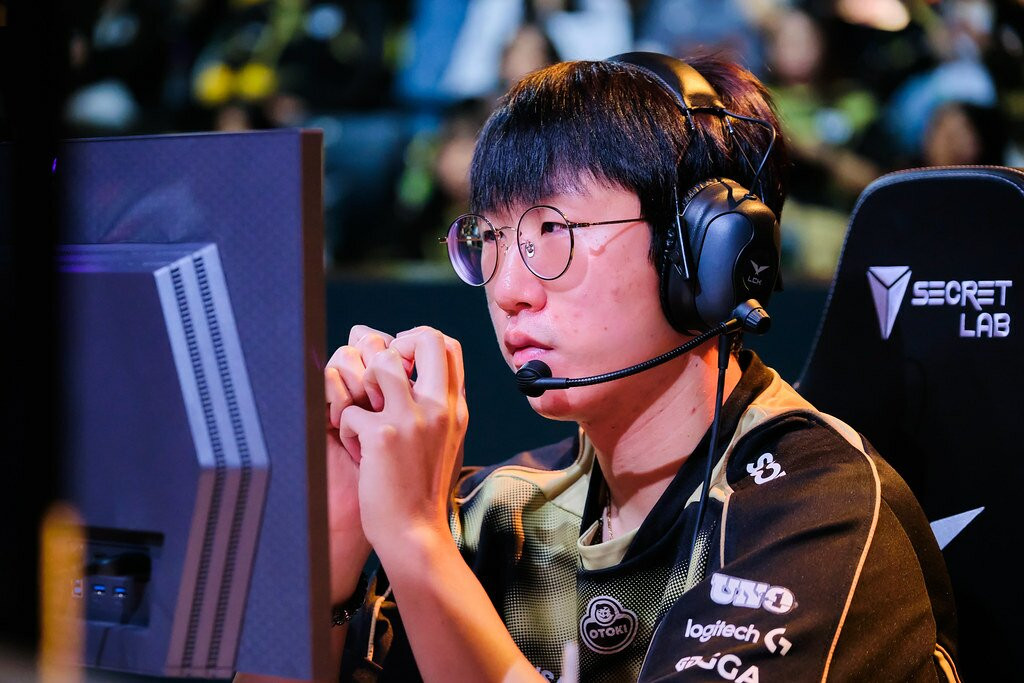
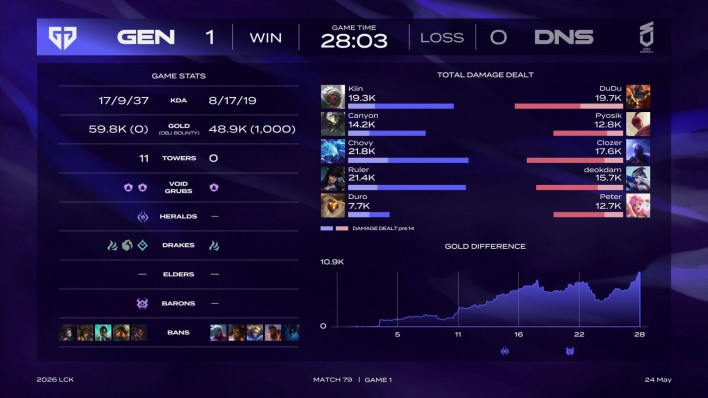
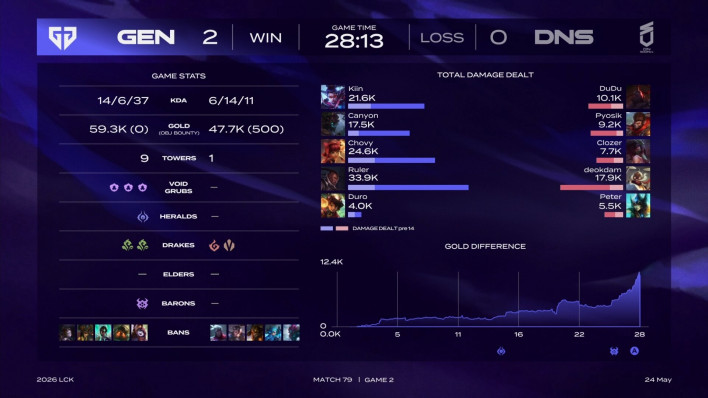
Gen.G Esports defeated DN Supers 2-0 in the second round of the 2026 League of Legends Champions Korea (LCK) regular season, held at LoL PARK in Jongno on the 24th. In both sets, the team secured double kills via bottom-lane dives before the four-minute mark, cruising to victory without facing any significant threats.
Gen.G took the first set. After a strong start with two kills from an early bottom-lane dive, they widened the gap significantly by scoring multiple kills in a top-lane skirmish. By the 13-minute mark, they held a 5k-gold lead. Although DN Supers managed to counter some of Gen.G’s aggressive plays, the deficit was already too large. Gen.G kept up the pressure until the end, finishing with a 10k-gold lead before destroying the Nexus.
The second set began similarly, with Gen.G securing two kills via a bottom-lane dive at the four-minute mark. This time, however, DN Supers responded quickly, sending ‘DuDu’ Lee Dong-ju’s Sion and ‘Clozer’ Lee Ju-hyeon’s Akali to the bottom lane to take down ‘Duro’ Ju Min-gyu’s Milio. Despite falling behind in CS across all lanes, DN Supers managed to catch ‘Canyon’ Kim Geon-bu’s Maokai and secure two dragon stacks, maintaining a much better atmosphere than in the previous set.
However, around the 20-minute mark, Gen.G denied DN Supers their third dragon. Although ‘Chovy’ Jung Ji-hun’s Annie was caught first in the ensuing team fight, the two ADCs—’Kingen’ Kim Ki-in on Vayne and ‘Ruler’ Park Jae-hyuk on Lucian—survived until the end to lead the team to victory. The gold lead instantly ballooned to over 5k. Following a series of winning streaks, Gen.G pushed into the base with the Baron buff and closed out the second set without any upsets.
[Read Original]
PakarPBN
A Private Blog Network (PBN) is a collection of websites that are controlled by a single individual or organization and used primarily to build backlinks to a “money site” in order to influence its ranking in search engines such as Google. The core idea behind a PBN is based on the importance of backlinks in Google’s ranking algorithm. Since Google views backlinks as signals of authority and trust, some website owners attempt to artificially create these signals through a controlled network of sites.
In a typical PBN setup, the owner acquires expired or aged domains that already have existing authority, backlinks, and history. These domains are rebuilt with new content and hosted separately, often using different IP addresses, hosting providers, themes, and ownership details to make them appear unrelated. Within the content published on these sites, links are strategically placed that point to the main website the owner wants to rank higher. By doing this, the owner attempts to pass link equity (also known as “link juice”) from the PBN sites to the target website.
The purpose of a PBN is to give the impression that the target website is naturally earning links from multiple independent sources. If done effectively, this can temporarily improve keyword rankings, increase organic visibility, and drive more traffic from search results.