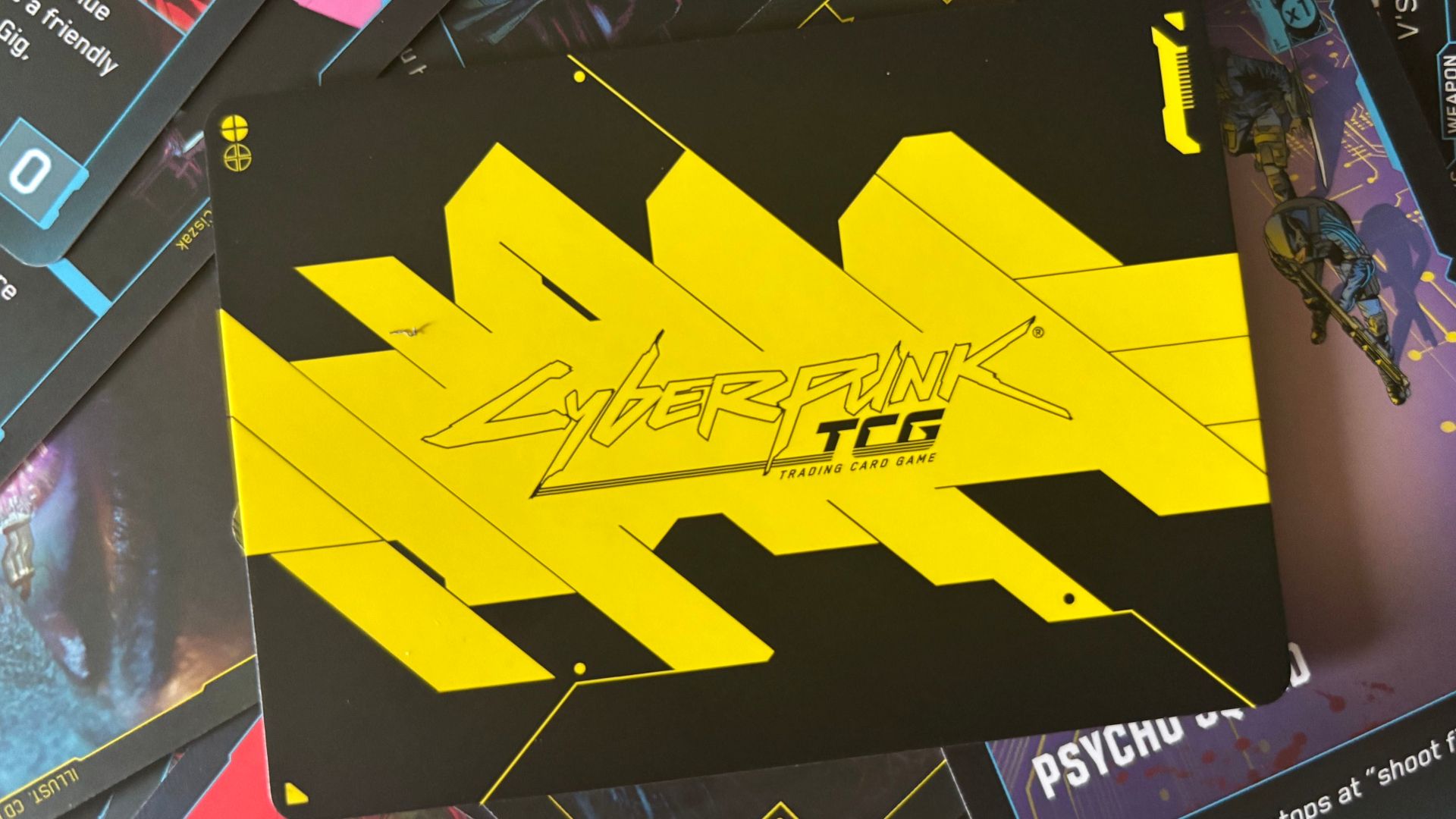
If you’ve played a trading card game in the last 10 years, chances are good that you’ll understand much of what the Cyberpunk Trading Card Game (henceforth referred to as simply Cyberpunk TCG) from Weird Co is doing. It’s pretty common for a new TCG to use bits and pieces of successful formulas elsewhere – resource management a bit like Lorcana, unit combat close to the Gundam TCG – while introducing some new complexity or change we don’t tend to see with the best card games.
For Cyberpunk TCG, that’s a whole entire (and unusual) dice mechanic. The dice are tied to the game’s win condition and a bunch of other mechanics that care about the numbers on them, but don’t be fooled: after playing it for myself at Gen Con 2026, it looks a lot more complicated than it actually is.
There’s a whole Cyberpunk TCG gameplay guide that you can read through, if that’s your speed, but the short version is that you have to start your turn with at least seven “Gigs” to win with each die representing a single Gig. Because you gain one of your own dice at the start of your turn, but only have six of your own, that means you have to attack with units to take at least one from your opponent, but that’s where you start getting into the deep end.
Latest Videos FromGamesRadar+
For every 10 power a given unit has, it steals an additional Gig. For if you have a unit attacking successfully with 11 power, you take two dice. But maybe there are blockers intercepting you, or maybe you want your Street Cred – the sum of all the Gig dice in your area – to be above or under a specific number or you want your rivals to be above or under a specific number.
What do you do then, choom? That’s what separates the Cyberpunk TCG from the rest.
It’s not perfect, and a 40-minute demo with decks explicitly crafted to provide the best experience in which to learn the Cyberpunk TCG can hardly be considered reflective of what the game will look like when it does eventually release later this year. Increasingly, however, it is my belief that the ability of a new TCG to break through years of calcification has more to do with shipping logistics and stock availability than it does any kind of game design.
But, for what it’s worth, I am very much looking forward to seeing more of the Cyberpunk TCG ahead of its release later this year.
It’s an exciting time to be a fan of TCGs; alongside news on Pokemon TCG Delta Reign, the Palworld TCG dev promises more stock with a 2nd Edition printing, and Disney Lorcana is getting an MTG Arena-style digital game.
PakarPBN
A Private Blog Network (PBN) is a collection of websites that are controlled by a single individual or organization and used primarily to build backlinks to a “money site” in order to influence its ranking in search engines such as Google. The core idea behind a PBN is based on the importance of backlinks in Google’s ranking algorithm. Since Google views backlinks as signals of authority and trust, some website owners attempt to artificially create these signals through a controlled network of sites.
In a typical PBN setup, the owner acquires expired or aged domains that already have existing authority, backlinks, and history. These domains are rebuilt with new content and hosted separately, often using different IP addresses, hosting providers, themes, and ownership details to make them appear unrelated. Within the content published on these sites, links are strategically placed that point to the main website the owner wants to rank higher. By doing this, the owner attempts to pass link equity (also known as “link juice”) from the PBN sites to the target website.
The purpose of a PBN is to give the impression that the target website is naturally earning links from multiple independent sources. If done effectively, this can temporarily improve keyword rankings, increase organic visibility, and drive more traffic from search results.